




Coup de coeur RESEARCH
Could biocidal nanoparticles be a solution to healthcare-associated infections?
Hospital-acquired infections, contracted in healthcare facilities. According to data from Santé Publique France in 2022, up to 23% of patients in intensive care are believed to be infected, leading to the use of preventive and curative antibiotic therapy for one in two patients in intensive care and one in four patients in surgical or medical wards. This excessive use of antibiotics subjects pathogens to strong selective pressure, leading in some cases to treatment dead-ends due to the emergence of antibiotic resistance.
In addition to therapeutic approaches, the search for materials with microbicidal properties to coat surfaces that come into contact with pathogens represents a promising avenue for innovation.
What exactly are they? Nanoparticles (NPs), with their nanoscale size, possess unique chemical and physical properties. Metallic nanoparticles, particularly those made of metal oxides, are known for their antimicrobial effects. These nanoparticles act directly on microorganisms: they can alter their cell walls, induce oxidative stress, disrupt their metabolism, and even interfere with their genetic material. Incorporating these nanoparticles into coating material formulations would serve as a preventive measure against nosocomial infections.
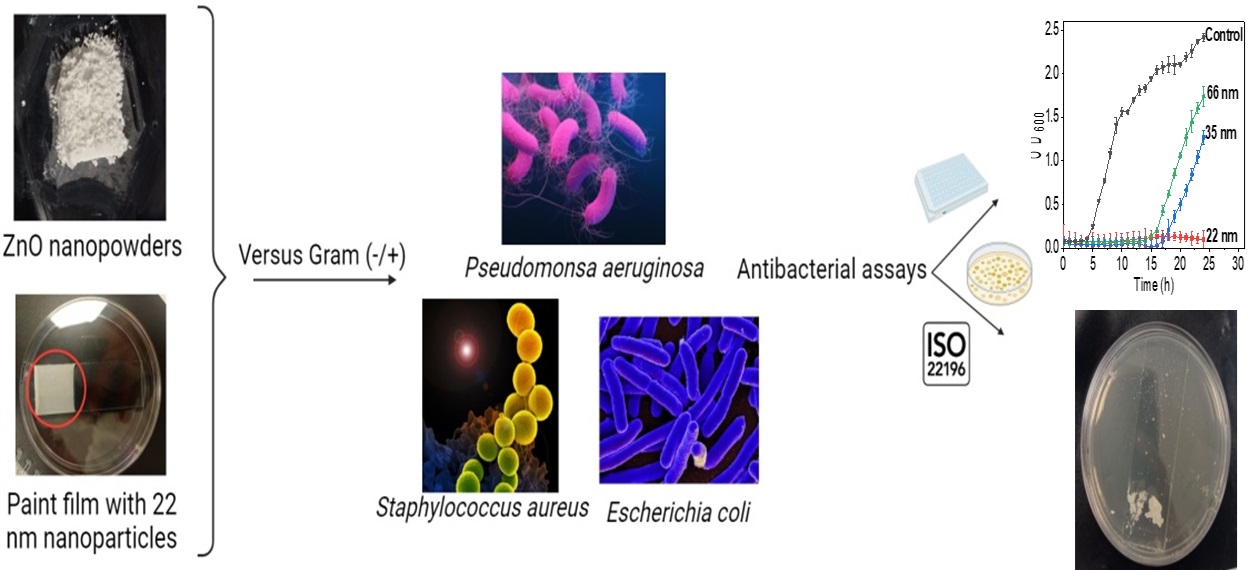
EBInnov® is developing a research program on this topic in collaboration with the Laboratory of Process and Materials Sciences (LSPM, CNRS UPR3407) at Sorbonne Paris Nord University (USPN). Initial studies (Dadi et al 2021, Dadi et al 2019) identified the NPs exhibiting the highest activity in colloidal solutions and as thin films (ZnO, CuO, and TiO2). More recently, studies have focused on the effect of NP size on their antibacterial activity in order to optimize the formulation by limiting aggregation phenomena (El Habib et al 2023). At the same time, preliminary results have shown low cytotoxicity of the selected NPs on human fibroblast cultures.
If their safety is confirmed, these NPs could be used to coat surfaces in hospital settings and medical equipment, or incorporated into textiles, thereby transforming the way we prevent and control healthcare-associated infections, in addition to current hygiene practices and treatments.
Check out our articles:
- https://www.sciencedirect.com/science/article/pii/S0928493119307192
- https://www.mdpi.com/2079-4983/15/7/195
Your contacts: Rabah Azouani, Karim Senni