





EBI Décrypte : comment la fraise devient gelée
Every year, the return of warmer weather also heralds the return of the strawberry, an emblematic spring fruit whose peak season in France runs from May to June. Contrary to popular belief, the strawberry is a “false fruit” in the botanical sense: the red, fleshy part we eat comes from the floral receptacle, while the true fruits are the small seeds visible on its surface, called achenes. For the sake of simplicity, this article will nevertheless use the common term “fruit” to refer to the strawberry. While readily available at market stalls, the strawberry is a particularly perishable product. Fragile and susceptible to spoilage, it must be consumed quickly or processed. Among the many possible uses, jelly is a particularly interesting example: how can such a delicate fruit give rise to a stable product with a firm and translucent texture? Behind this transformation lie precise physicochemical mechanisms, at the heart of life sciences and food processing.
The strawberry: a rich biological matrix… but unstable
Strawberries are composed of approximately 90% water, which explains their high susceptibility to spoilage. This high water content results in high water activity, meaning a large amount of free water available in the fruit, which promotes the growth of microorganisms such as bacteria, yeasts, and molds. Furthermore, certain enzymes naturally present in the fruit remain active after harvesting and contribute to spoilage.
Strawberries also contain simple sugars (glucose, fructose), organic acids (primarily citric acid), as well as fiber and pectin. Pectin, a polysaccharide found in plant cell walls, plays a crucial role in the gelling process [1].
These characteristics explain the high sensitivity of the strawberry and direct processing methods towards mechanisms that stabilize its matrix, such as gelation.
Jelly: a transformation guided by physico-chemistry
Strawberry jelly is made from clarified fruit juice, meaning juice that has been freed of solid particles such as pulp, fiber, or cell fragments. When heated with sugar and a complementary gelling agent, this juice yields a homogeneous and translucent preparation.
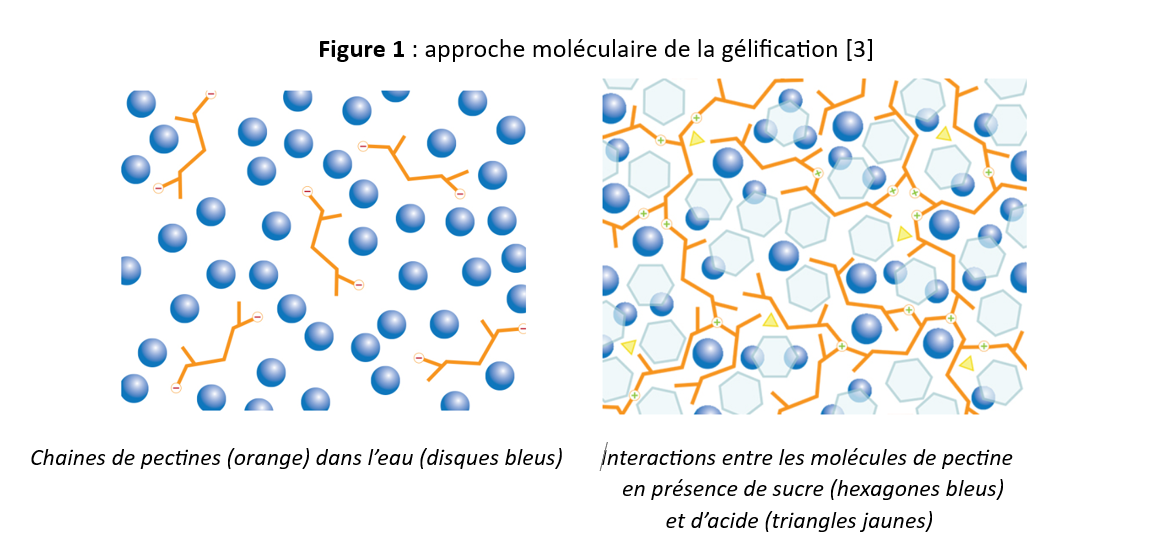
The gelling process involves an essential trio: pectins, sugar, and acids [2].
- Pectins, negatively charged, repel each other like magnets. Stratagems are necessary for them to meet and combine to form a three-dimensional network capable of retaining water and structuring the gel.
- Sugar absorbs water and promotes interactions between pectin chains.
- The acids provide H+ ions which will neutralize the negative charges of the pectins, thus facilitating their assembly.
During cooking, the heat causes the fruit’s cellular structures to rupture, releasing pectin into the surrounding environment. Simultaneously, the evaporation of water concentrates the sugars, a crucial condition for gel formation, especially with the addition of lemon juice. The pectin chains then bind together to form a network capable of trapping water: the preparation gradually transforms from a liquid state into a biphasic system consisting of a macromolecular network encompassing a liquid phase, characteristic of food gels.
Temperature plays a central role in reaching the “freezing point,” often determined empirically in cooking. From a scientific perspective, this point corresponds to a precise balance between sugar concentration, acidity, and molecular structure. Insufficient or excessive heating can therefore compromise the final texture [4].
Why don’t all frosts “set”?
The success of a jelly depends on a precise balance between pectin content, sugar, and acidity. However, the composition of the fruit varies according to the variety, growing conditions, and especially the degree of ripeness.
During ripening, pectins evolve under the action of enzymes naturally present in the fruit. Fruits at optimal ripeness generally possess the best gelling properties, while very ripe fruits contain more degraded pectins, less able to form a gel [4].
When this balance is disrupted, various defects can appear:
- Pas assez de pectine ou fruits trop mûrs
→ la gelée reste liquide
→ Solution : ajouter de la pectine alimentaire - Pas assez de sucre
→ le gel reste mou et peut relarguer de l’eau
→ Solution : utiliser davantage de sucre ou un sucre gélifiant - Not enough acidity
→ the pectin network breaks down
→ Solution: add lemon juice
Texture directly influences the sensory perception of the product. The pectin network, in particular, allows for a gradual release of aromas in the mouth, contributing to the taste experience.
This is where the sensory expertise of EBInnov®, EBI’s in-house research unit, can come into play to characterize product perception. Thanks to its expert panels, the team develops specific protocols to evaluate appearance, texture, and organoleptic properties, with applications particularly in quality control.
In the food industry, formulations are precisely adjusted through the use of standardized pectins and the control of pH and sugar content. These parameters guarantee consistent products despite natural variations in the raw materials. Jelly is therefore a relatively stable product: the reduction in water activity due to the sugar, combined with its acidity, limits microbial growth and improves preservation.
Today, however, reducing sugar content represents a major challenge for manufacturers. This implies developing new formulations, using, for example, other types of pectins or alternative processes in order to preserve the texture and stability of the product.
A few tips for making perfect jelly
- Choose quality fruit, perfectly ripe
- Respecter précisément les proportions de fruits, de sucre et de jus de citron
- Utiliser une casserole large à fond épais évasée afin de mieux répartir la chaleur, favoriser l’évaporation et réduire le temps de cuisson
- Monitor the cooking process: the gelling point can be checked using a cold spoon. At the beginning of cooking, the mixture flows in drops; the characteristic gel texture is reached when the drops join together to form a ribbon [5].
Derrière une tartine, une ingénierie du vivant
La transformation de la fraise en gelée illustre parfaitement la manière dont la maîtrise des interactions moléculaires permet de créer de nouvelles textures tout en améliorant la conservation des aliments. Derrière un geste culinaire du quotidien se cache une véritable ingénierie du vivant, mobilisant des connaissances en chimie, en biologie et en génie des procédés.
Delphine HERMOUET, Marjorie LASSALLE, Chrystel NEFF
[1] Giampieri, F. et al. (2012). The strawberry: Composition, nutritional quality, and impact on human health. Nutrition, 28(1), 9–19.
[2] Je pense donc je cuis. Les confitures maison : une relation à 3 qui finit bien, en général. 8 Sep, 2016. Consulté le 12/05/2026 sur : https://jepensedoncjecuis.com/2016/09/les-confitures-maison-une-relation-3.html
[3] Devil’s food kitchen. Food science: fruit preserves. June 1, 2016 . Consulté le 12/05/2026 sur : https://devilsfoodkitchen.com/2016/06/01/the-science-of-jam/
[4] Thakur, B. R., Singh, R. K., & Handa, A. K. (1997). Chemistry and uses of pectin. Critical Reviews in Food Science and Nutrition, 37(1), 47–73.
[5] Blais, C. (2007). La chimie des desserts : tout comprendre pour mieux les réussir. La Presse, p. 145.