





EBI deciphers: solar products
Science, skin and prevention
If the sun remains an essential source of vitality and well-being, its interaction with our skin requires an informed approach. In light of recent scientific advances in photoprotection, sunscreens prove to be much more than summer companions: daily allies to combine luminous benefits with skin preservation. This report explains how to cultivate a serene relationship with light—where protection rhymes with education rather than deprivation.
UV Risks: Invisible Threats on the Epidermis
Ultraviolet rays (UVB and UVA), emitted by the sun, are invisible to the naked eye but have harmful effects on the skin. UVB rays penetrate the superficial layers of the skin. They are mainly responsible for sunburns and the majority of DNA alterations that can lead to skin cancers. UVA rays, which are more abundant and more penetrating, act deeper: they accelerate skin aging (appearance of wrinkles, pigment spots, loss of elasticity) and also contribute to the formation of skin cancers. Unlike UVB, UVA rays pass through clouds, glass, and are present throughout the year. Repeated and unprotected exposure to UV can cause irreversible cellular damage, weaken the skin’s immune system, and significantly increase the risk of melanoma. Hence the importance of rigorous and regular sun protection, even on cloudy days in the absence of apparent sunlight.
Protections: chemical-mineral filters
Sunscreens are specifically formulated to protect the skin against ultraviolet (UV) radiation. They contain UV filters that fall into two categories: mineral filters such as zinc oxide or titanium dioxide, which act by reflecting UV rays; and organic (chemical) filters such as avobenzone or octocrylene, which absorb them.
However, some of these substances are currently being reassessed. This is the case with octocrylene, which is suspected of being an endocrine disruptor and whose degradation over time can lead to the formation of benzophenone, a compound suspected of being carcinogenic. In addition, studies have shown that certain chemical filters may negatively impact marine ecosystems, particularly coral reefs.
As a result, more and more sunscreen products are adopting “reef-safe” formulas, excluding controversial filters and favoring compositions that are more respectful of both health and the environment. It is recommended to choose a broad-spectrum protection (UVA and UVB), with an appropriate SPF, and to pay attention to the product’s composition, especially for sensitive skin or children.
The UV protection index
The sun protection factor, or SPF (Sun Protection Factor), indicates the level of protection a product provides against UVB rays, the primary cause of sunburn. For example, an SPF 30 means it takes 30 times longer for a sunburn to appear compared to unprotected skin. The higher the factor, the stronger the protection: SPF 15 blocks about 93% of UVB, SPF 30 blocks 97%, and SPF 50 about 98%. However, no product provides 100% protection. The choice of SPF depends on skin type, exposure time, sun intensity (UV index), and location (sea, mountains, etc.). It is also essential that the cream offers broad-spectrum protection, that is, against UVA in addition to UVB – often indicated by a circular logo or the mention “UVA” on the packaging.
And the composition?
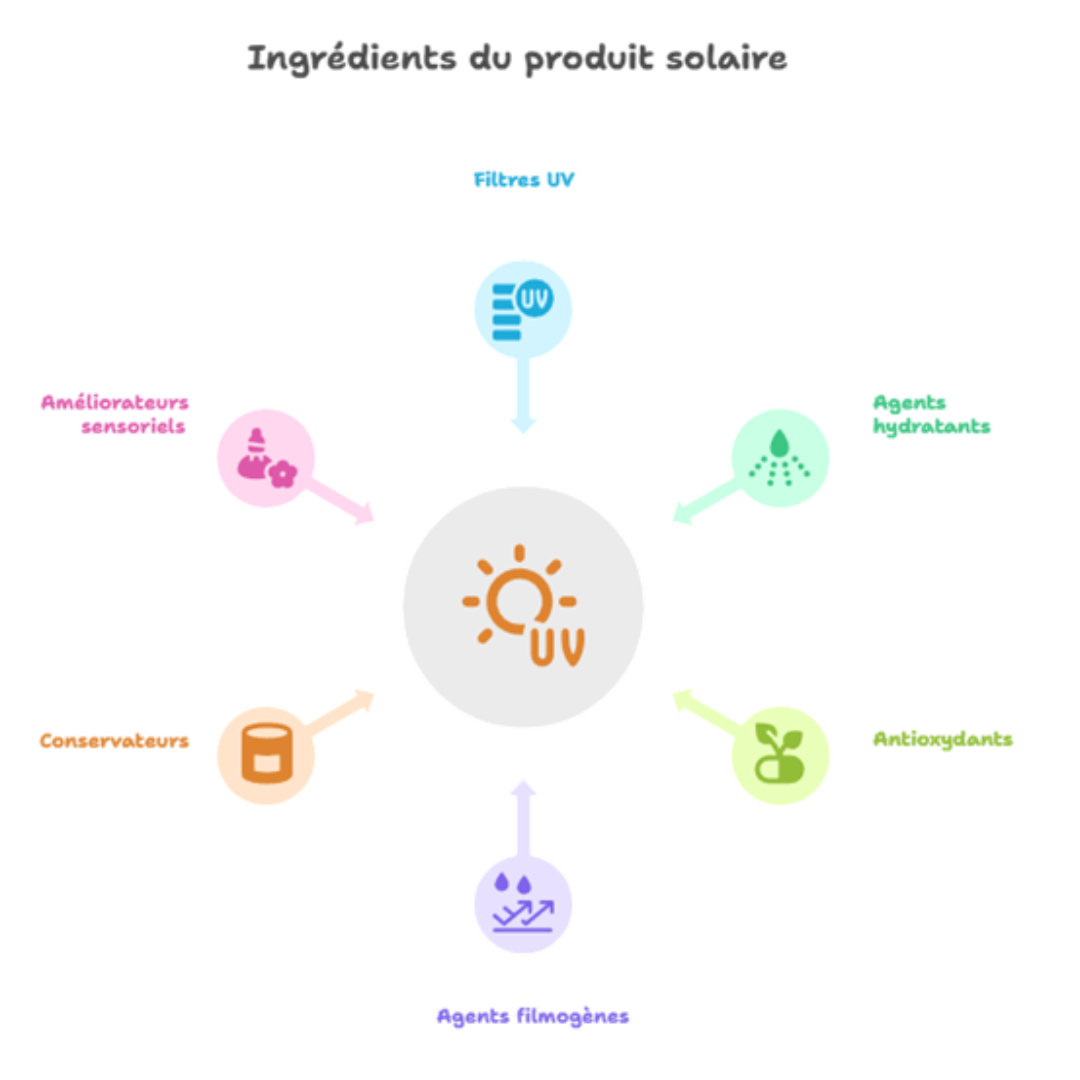
In a sunscreen product, each ingredient plays a very specific role: protecting the skin from UV rays, ensuring the stability and durability of the formula, and providing a pleasant, sensory application experience.
In addition to UV filters, the formula contains moisturizing agents such as glycerin, hyaluronic acid, or aloe vera, which help the skin remain supple despite sun exposure. It also includes antioxidants, such as vitamin E or panthenol, which strengthen the skin’s defenses against oxidative stress caused by UV rays.
To ensure a pleasant texture and good wear, film-forming agents or emollients are added to the formula. These help make the product resistant to water and sweat while facilitating its application. Preservatives are also included to maintain the product’s stability, especially when exposed to heat.
Finally, some sunscreen products may contain fragrance, colorants, or other so-called “secondary” ingredients that enhance the sensory experience. However, these components may not be suitable for sensitive, reactive, or allergy-prone skin.
Checklist for optimal sun protection
Thus, in order to minimize the risks of skin damage and premature aging related to sun exposure, the essential aspects to consider are the following:
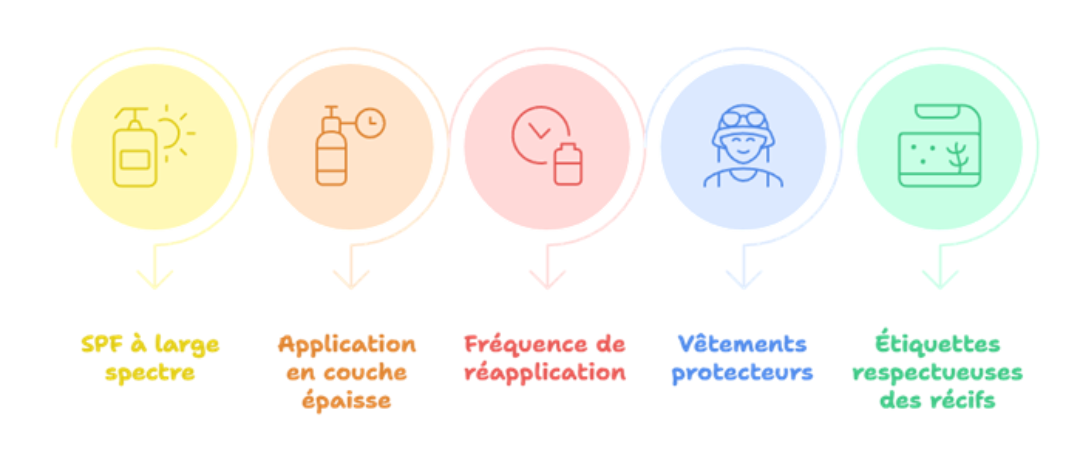
✅Choice of a SPF 50+ broad spectrum (UVA+UVB)
Choose an SPF 50+, especially for sensitive skin or during prolonged exposure. It is also essential to choose a sunscreen that protects against both UVA and UVB rays. The product should clearly mention ‘broad spectrum’ protection or indicate UVA protection in addition to the SPF rating.
✅ Application in a thick layer (2 mg/cm²)
For effective protection, it is recommended to apply about 2 mg of sunscreen per square centimeter of skin. This is roughly equivalent to about a teaspoon (5 ml) for the face and neck, and about half a cup (30 ml) for the whole body. The sunscreen should be applied evenly to all exposed areas, including the ears, neck, backs of the hands and feet, as well as often neglected areas such as around the eyes and lips (use a lip balm with SPF). Remember to apply it 15 to 30 minutes before sun exposure to allow the skin to absorb the cream properly.
✅ Every 2 hours
Reapply sunscreen every two hours, more frequently after swimming or physical activity, and also avoid sun exposure during the hottest hours of the day (10 a.m. – 4 p.m.)
✅ Additionally: UPF 50+ textiles, UV400 sunglasses, and hat
Clothing with a UPF 50+ rating blocks 98% of UV rays. They are particularly useful for protecting areas of the body that are difficult to reach with sunscreen, such as the back or shoulders. These clothes are ideal for outdoor activities, such as hiking, swimming, or gardening. UV400 sunglasses block 100% of UVA and UVB rays. They are essential for protecting your eyes from sun damage, such as cataracts and macular degeneration. Your hat is also a valuable ally.
✅ Checking ‘reef-friendly’ labels
Some chemical sunscreens are harmful to coral reefs and marine ecosystems. They can contribute to coral bleaching and disrupt the reproduction of marine organisms. More environmentally friendly alternatives exist, and the label “reef-friendly” or “ocean-friendly” is indicated on the products.
Sources:
- ANSES (2025) Recommendations on sun care products https://www.anses.fr/fr/content/produits-de-protection-solaire-mieux-informer-les-consommateurs-pour-une-meilleure-protection
- Mélanie Côme. The skin microbiota: the sunscreen of tomorrow. Pharmaceutical Sciences. 2023. dumas-04305046
- Marguery MC. Photoprotection (internal and external). Encycl. Méd. Chir. Dermatology 2001;98-944 A-10:11.
- JP Lacour, JC Béani. Natural photoprotection, external photoprotection (topical and clothing). Ann Dermatol Venereol 2007; 134:4S18-4S24.
- EU Regulation 2025/1223 on the criteria for UV filters.