






EBI Deciphers: The secrets of madeleines
Madeleines, biscuits that are not as simple as they seem
Madeleines are small traditional French cakes, recognizable by their domed shell shape and golden color.
Popularized at the French court in 1755, they remain highly appreciated today [1][2] by both children and adults, especially thanks to their soft texture and delicious buttery taste, which often evokes childhood memories. But behind this apparent simplicity, the success of the recipe lies in genuine expertise.
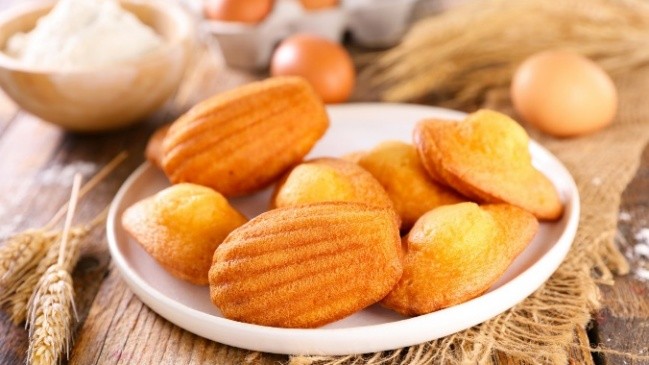
Madeleines, simple yet demanding cakes
The key to the madeleine dome: thermal shock
The characteristic domed shape of madeleines is no accident! It results from a thermal shock during baking. When the cold batter suddenly comes into contact with a very hot oven, a significant temperature difference occurs between the outside and inside of the cake. The outer crust sets quickly, while the inside continues to expand under the heat. This internal expansion pushes the batter upwards, forming the characteristic dome. To achieve this result, two conditions are essential:
- A well-rested and cold dough before baking (often placed in the refrigerator);
- A high oven temperature at the start of cooking, often around 220°C, before reducing it afterwards to continue cooking without burning the crust.
This interplay of temperatures creates the little magic of madeleines: a golden shell on the outside and a soft, puffy center inside. But baking isn’t everything!

The domed shape of madeleines, a physical phenomenon
Understanding softness
In the food industry, “moelleux” refers to a tender, melt-in-your-mouth, and airy texture. For madeleines, maintaining this softness over time is a real challenge because their high fat content makes them particularly susceptible to drying out and going rancid, two phenomena that cause them to become drier and alter their taste.
Beyond a simple texture defect, these alterations can have a direct impact on consumer satisfaction. A madeleine deemed too dry or with an altered taste will be perceived as lower quality, which will undoubtedly discourage repeat purchases. Preserving the moist texture is therefore not just a matter of taste pleasure: it is also a key issue for marketing and brand image.
This quality can be easily assessed by a consumer panel (a sample of testers): by pressing the cake between your thumb and forefinger, you can appreciate its ability to quickly regain its original shape and the feeling of lightness it provides. The more the madeleine resists drying out and quickly becomes soft again, the more it is considered to be moist.
But the evaluation doesn’t stop there. Expert panels, such as those trained at the School of Industrial Biology within the EBInnov® Research Unit, allow for a more in-depth analysis. Thanks to their training in sensory science, these experts are able to break down perceived sensations (elasticity, moisture, melt-in-your-mouth texture, etc.) and assess the quality of the softness more objectively and reproducibly. These detailed analyses complement the perceptions of consumer panels and help identify the parameters that truly influence the product’s texture.
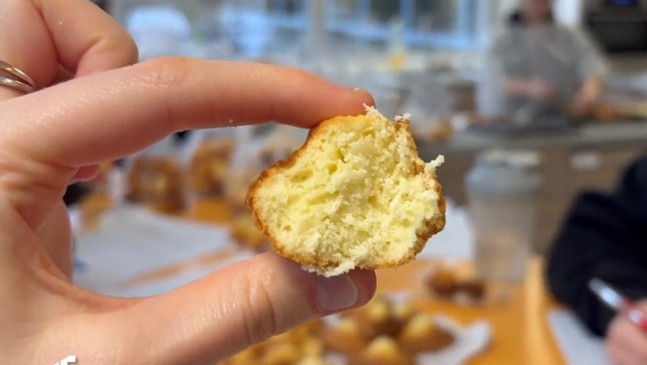
The “softness to the touch” test carried out by the EBInnov® sensory panel
To complement sensory analysis, EBI also uses instrumental methods, such as the texture analyzer, which applies force to the product and measures its reaction. These measurements of hardness, cohesion, and elasticity can be correlated with panel perceptions, providing a precise and comprehensive understanding of the factors that determine softness, from perception to objective quantification.
How ingredients influence softness
The final texture depends on several key ingredients. Flour influences elasticity: a T45 flour, richer in gluten, makes the batter more supple and firm. Whipped egg whites incorporate air into the batter, making the madeleine lighter and airier. Clarified butter not only provides buttery flavor but also moisture and suppleness, like oil, improving the texture without compromising the flavor. Finally, sugar and milk play a role in retaining moisture and help maintain the softness for longer.
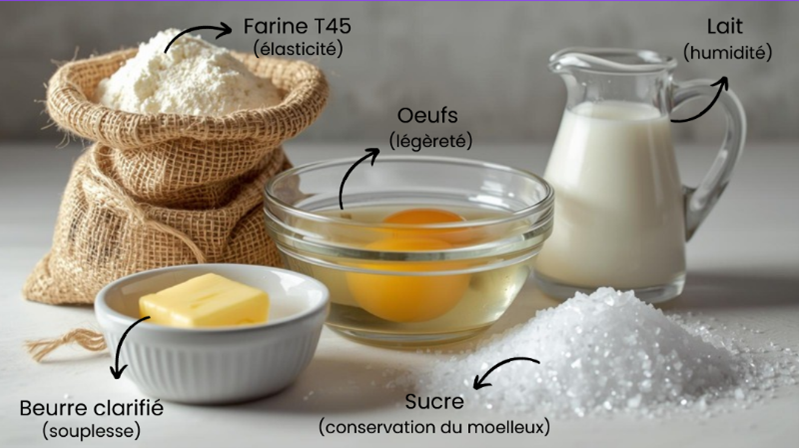
Each ingredient plays its role in the texture
By combining these different elements, it is possible to control and optimize the texture of the madeleines to obtain quality cakes that are tender, melt-in-your-mouth and pleasing to the taste.
References
[1] « Charte-BG-2024-VF-validee-CA-du-4-decembre-2024-.pdf ». Consulté le: 12 juin 2025. [En ligne]. Disponible sur: https://www.alliance7.com/wp-content/uploads/2025/01/Charte-BG-2024-VF-validee-CA-du-4-decembre-2024-.pdf
[2] A. Denis, « Les biscuits et gâteaux : toute une diversité », Cahiers de Nutrition et de Diététique, vol. 46, no 2, p. 86‑94, avr. 2011, doi: 10.1016/j.cnd.2010.11.002.