






EBI Deciphers: The Secrets of Chocolate
Chocolate: Understanding its transformations
As Easter approaches, chocolate appears in all its forms: shiny eggs, crunchy chocolates, and melting hearts. Behind these delectable treats, however, lies a substance far more complex than it seems. Solid, melting, glossy, or brittle, chocolate is an ingredient capable of true metamorphoses, closely linked to its structure and the conditions under which it is worked. Understanding these transformations means not only better grasping the techniques of chocolatiers and pastry chefs, but also unlocking the secrets of a successful texture and a perfectly controlled appearance.
The composition of chocolate: a subtle architecture
Chocolate is a complex system composed primarily of cocoa, cocoa butter, and sugar, to which powdered milk may be added depending on the recipe. From a physicochemical standpoint, it is a dispersion of solid particles—cocoa and sugar—within a continuous fatty phase, cocoa butter, which is solid at room temperature. This particular structure largely explains its unique properties and its sensitivity to temperature variations.
At the heart of this structure, cocoa butter plays a crucial role. This fat, with its unique physicochemical properties, can crystallize in several forms. Below 27°C, cocoa butter is completely solid, while above 35°C, it melts and becomes liquid. Between these two temperatures, it can adopt different crystalline structures. This microscopic organization directly influences the properties of chocolate, both in terms of appearance and texture: shine, snap, and melt-in-the-mouth feel. This is why chocolate is particularly sensitive to temperature variations and the techniques of chocolatiers and pastry chefs, which constantly affect its structure.
Tempering: Mastering the Metamorphosis of Chocolate
Among the key techniques in chocolate making, tempering is undoubtedly one of the most crucial—and most delicate. It involves subjecting the chocolate to a precise temperature curve to control the crystallization of the cocoa butter. Indeed, as a polymorphic lipid, cocoa butter crystallizes in six different forms with varying physical characteristics, but only one of them—the so-called “stable” form—gives the chocolate its desired qualities. Without tempering, chocolate can appear dull, develop whitish streaks (a phenomenon known as fat bloom), and lose its crispness.
The principle of tempering is based on three steps: a temperature increase to melt all existing crystals, a controlled cooling to initiate the formation of certain crystals, and then a slight temperature increase to eliminate unstable forms. This process allows the material to be “guided” towards an optimal organization.
In both pastry and chocolate making, mastering tempering is essential. It determines not only the visual appearance of creations—moldings, coatings, decorations—but also their texture and stability. Behind this technical skill lies a true transformation of the material, where thermal precision becomes the tool chocolatiers and pastry chefs use to tame the complexity of chocolate.
The ideal crystallization form, which allows chocolate to be crisp, smooth, and shiny, is the V crystallization form, which has a melting point of 33.8°C. Furthermore, V-type crystals allow chocolate to melt delicately in the mouth, but not between the fingers.
The challenge for chocolatiers and pastry chefs is therefore to specifically promote the formation of this crystalline form through tempering. This involves melting the chocolate at a temperature between 50-55°C to eliminate all the crystals. The chocolate is then cooled to 28-29°C: type IV and V crystals form (type VI forms too slowly and doesn’t have time to appear). Once this temperature is reached, it is heated again to 31-32°C to eliminate the type IV crystals, leaving only the type V crystals.[1]
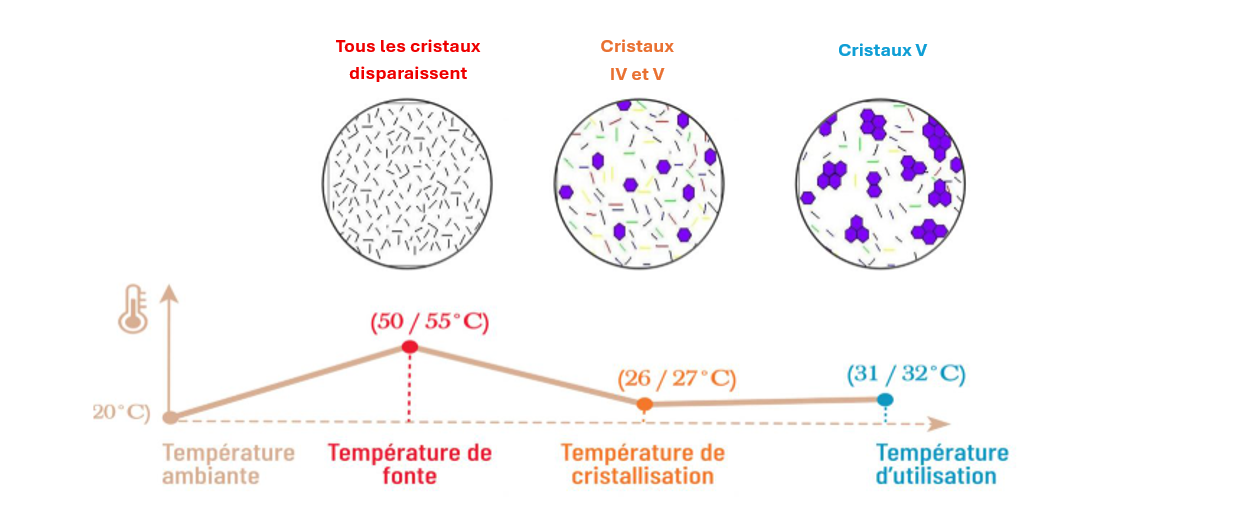
Figure 1: Evolution of cocoa butter crystals as a function of temperature [2]
This temperature control can be studied in detail using analytical tools. Rheology, which studies the flow and deformation of materials, allows us to characterize the behavior of chocolate. It is thus possible to track the evolution of its viscosity during a gradual temperature increase. This approach allows us to precisely identify phase transitions and, in particular, the melting point associated with different crystalline forms [3].
The drawbacks of improper tempering
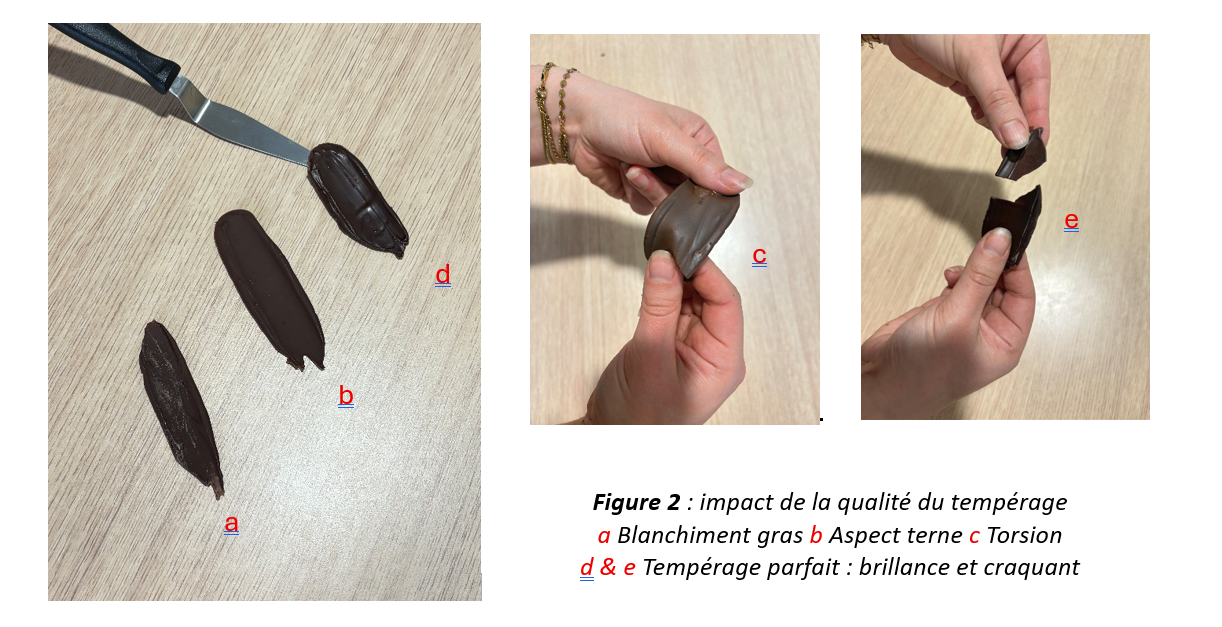
Improper tempering quickly results in visible defects. The most common is the appearance of a whitish film on the surface of the chocolate, known as fat bloom (Figure 2a). This phenomenon is caused by the uncontrolled migration and crystallization of cocoa butter, which reorganizes itself on the surface. While harmless to eat, it detracts from the visual appearance and indicates a disorganized structure.
Other defects may also appear: a dull chocolate (figure 2.b), without shine, a soft (figure 2.c) or crumbly texture, or an absence of “snap”, that characteristic clear sound when breaking.
These alterations reflect poor organization of the lipid crystals, often due to poorly controlled temperature variations. These defects are not merely aesthetic: they impact the perceived quality of the product and its long-term stability. Thus, behind every shiny and crisp chocolate (Figure 2, d&e) lies a meticulous mastery of the physical transformations of the material.
Poorly structured chocolate will alter the overall consumer experience: beyond the chocolate’s appearance, the mouthfeel becomes uneven, sometimes pasty, and the crunch disappears. This is where the sensory expertise of EBInnov®, EBI’s proprietary research unit, can come in to characterize perception. Thanks to its expert panels in texture, smell, and taste, the team can evaluate the appearance, feel, and mouthfeel to understand how each physical defect translates into a sensory experience.
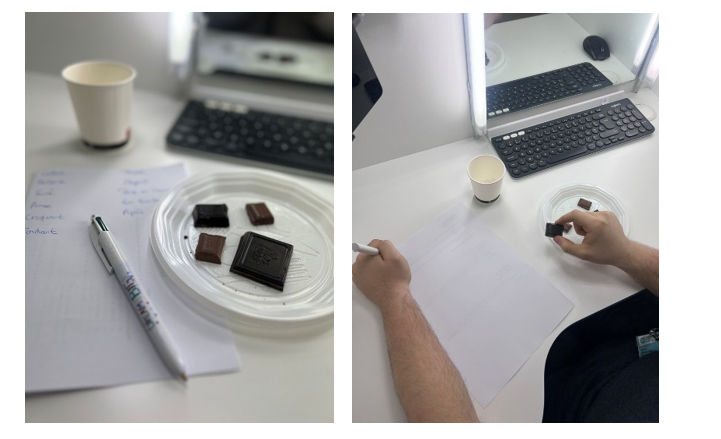
Figure 3: Sensory “taste” session at EBInnov®
Thus, behind every gourmet creation lies a subtle science: understanding the metamorphosis of chocolate means transforming a capricious material into a precision instrument for pastry and chocolate making.
Sylvia Imbart, Delphine Hermouet, Marjorie Lassalle, Chrystel Neff
***
[1] « Oui, le tempérage du chocolat est indispensable!!! », Qui léchera la cuillère. Consulté le : 25 mars 2026. [En ligne]. Disponible sur : https://quilecheralacuillere.fr/oui-le-temperage-du-chocolat-est-indispensable/
[2] J. P. donc J. Cuis, « Apprenez le tempérage pour des chocolats maison brillants et cassants », Je Pense donc Je Cuis. Consulté le : 25 mars 2026. [En ligne]. Disponible sur : https://jepensedoncjecuis.com/2022/04/apprenez-le-temperage-pour-des.html
[3] « Étude rhéologique de produits alimentaires ». Consulté le : 31 mars 2026. [En ligne].
Disponible sur : https://wiki.anton-paar.com/ca-fr/notions-de-base-de-la-rheologie/etude
rheologique-de-produits-alimentaires