




EBI Deciphers: Collagen
Collagen, the invisible framework of our body
If skin retains its firmness, if joints absorb shocks, and if tissues resist mechanical stress, it is largely thanks to collagen. This protein, the most abundant in the animal body, forms a veritable support network that ensures cohesion, strength, and flexibility.
Collagens, a large family of proteins with multiple functions
The human body contains 28 types of collagen, which are the major proteins of the extracellular matrix. Thus, 30% of the proteins in our tissues are collagens, each composed of three peptide chains arranged in a triple helix of varying length. Within this helical region, glycine, the smallest amino acid, is present in one out of every three helical chains and is essential for structural stability. The replacement of this glycine by a larger amino acid in certain bone collagens can lead to osteogenesis imperfecta (brittle bone disease).
Collagens exhibit a wide range of structural diversity, allowing them to adopt various organizations and perform different functions. They can thus form fibers, planar networks, or, for some, be inserted into the cell membrane.
Fibrillary collagens are among the most abundant in the body. They give tissues mechanical strength and tissue cohesion. Among them, type I, III and V collagens are present, in varying proportions, in the skin, vessel walls, tendons and bone. Type II collagen is that of cartilage, where it combines with type IX collagen to form fibers. Another important collagen is type IV collagen. It is organized in planar networks and constitutes the heart of the structure which allows the epidermis to anchor firmly to the dermis in the skin, the dermo-epidermal junction.
Thus, in the skin, several types of collagen are present in the dermis, the hypodermis and at the interface between the dermis and the epidermis. They thus contribute to the mechanical resistance of this tissue by interacting closely with cells, but also with other macromolecules such as elastin, a major component of elastic fibers.
Highly controlled cell manufacturing
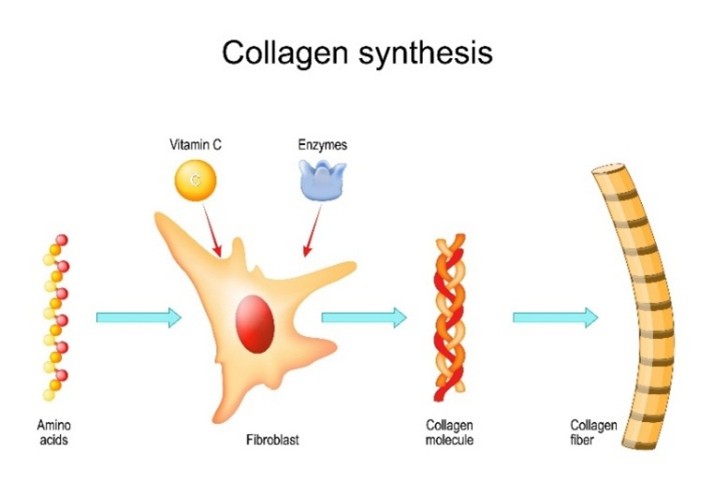
The production of fibrillar collagen is carried out by fibroblasts, the structural cells of the dermis. These collagens, rich in specific amino acids such as glycine, proline, and hydroxyproline, require essential cofactors for their synthesis, notably vitamin C and iron. A vitamin C deficiency causes scurvy, a well-known condition among sailors on long voyages in the 16th, 17th, and 19th centuries, characterized by tissue fragility.
Fibroblasts synthesize a precursor form, procollagen, which will then be transformed and assembled outside the cell to give rise to functional collagen fibers.
This mechanism is finely regulated. For example, the onset of wound healing begins with a high synthesis of type III collagen, allowing for rapid tissue repair. Then, progressively, the synthesis of type I collagen increases, forming increasingly larger fibers to strengthen the mechanical resistance of the scar tissue.
Les facteurs de dégradation, ennemis silencieux des collagènes ?
While skin gradually loses firmness and elasticity with age, this is largely due to the alteration of collagen, whose network weakens over time: the skin loses firmness and wrinkles appear.
The primary factor is intrinsic aging, also known as chronological aging. This is a natural process programmed by our genetics. Starting around age 25–30, the activity of fibroblasts—the cells responsible for collagen production—gradually declines. Synthesis slows down, while degradation mechanisms take over. The dermis thins, the fibers become less organized, and the skin gradually loses density. This phenomenon is inevitable, but it remains slow and progressive unless exacerbated by external factors.
In addition to this natural phenomenon, environmental aggressors also play a role. UV rays are the primary cause of photoaging: they generate free radicals that trigger oxidative stress, which activates enzymes called metalloproteinases (MMPs), responsible for breaking down collagen fibers. In the long term, this leads to disorganization of the dermal matrix and a phenomenon called solar elastosis, characterized by an accumulation of abnormal fibers and a loss of firmness. Tobacco use and pollution also exacerbate this degradation by increasing the production of free radicals and limiting the synthesis of new fibers.
Collagens and commercial products
The collagen used in industry (cosmetics, dietary supplements) today comes primarily from animal sources (bovine hide, bones, and tendons; fish skin, bones, and scales; and by-products of aquaculture and seafood processing). Marine collagen is often highlighted for its bioavailability. There is no plant-based collagen as such. Plant-based alternatives (legume proteins or polysaccharides) replicate some of collagen’s functional properties (film-forming effect, hydration) or stimulate endogenous synthesis, but they do not replace the protein in its biological structure.
Collagen extraction processes rely on several successive steps aimed at isolating and purifying the protein while preserving its structure. After mechanical pretreatment (cleaning, cutting, grinding), the raw materials undergo chemical treatment to break intermolecular bonds and solubilize the collagen. A purification phase is then carried out, possibly followed by controlled hydrolysis to produce peptides with a lower molecular weight. Today, environmental and ethical concerns are leading the industry to prioritize the valorization of agri-food by-products, reduce the use of chemical solvents, optimize water and energy consumption, and strengthen the traceability and sustainability of supply chains.
Drinkable collagen: what really happens to it in the body?
In its native form, the collagen molecule is too large to cross the intestinal barrier. It must be fragmented into smaller peptides to be absorbed. Research is converging on an optimal absorption window between 500 and 3,000 Da. Within this range, some peptides are absorbed almost completely and have been detected in blood plasma as early as 60 minutes after ingestion. These fragments then pass into the bloodstream. However, they are redistributed according to the body’s needs and not exclusively to the skin. Actual bioavailability, the effective dose, and the duration of effects remain active areas of research.
Towards next-generation collagens
To address the challenges of food safety, traceability, and sustainability, new production methods are emerging, such as recombinant collagens produced by micro-fermentation. This technology opens up possibilities for purer, reproducible ingredients that are independent of animal resources.
The EBI approach: from laboratory to market
Understanding collagens requires combining cell biology, protein physicochemical analysis, skin physiology, and considerations of formulation, bioavailability, and claims. This comprehensive approach fully illustrates the skills developed at EBI. From analyzing biological mechanisms to evaluating ingredient efficacy, the training and projects conducted at EBI enable future engineers to gain a scientific understanding of market trends.
Echoing this topic, the students of the Design & Development Major organized, on January 22, a scientific seminar dedicated to collagens, which they designed from A to Z, with expert lectures and practical workshops.
- Hereditary connective tissue disorders – Karim SENNI (EBI)
- Collagen and skin integrity – Valérie HAYDONT (L’Oréal)
- Collagen and dietary supplements – Mathieu BOUARFA (Nutrastream)
- Practical workshops: creation of gummies and formulation of masks (Students).
An event reflecting the image of EBI: a scientific theme at the heart of our sectors, an organization driven by students, an approach combining scientific rigor, concrete application and team spirit.
Students in the Design & Development major, Marjorie Lassalle, Karim Senni